

Since it was first announced, Christopher Nolan’s Odyssey produced two opposing narratives. As is so often the case these days, it came down to conservative hand-wringing over diversity in Hollywood. To frame this moral panic as academic critique, the big tagline became something like this: “Christopher Nolan’s Odyssey is HISTORICALLY INACCURATE and here’s why,” followed by hysteria over the high-profile casting of Lupita Nyong’o, Elliott Page, and so on.
What this then prompted, understandably, is pushback about where the line gets drawn in these debates. Odysseus was not, in fact, Bostonian. Outrage over the backgrounds of some cast members but not others is telling. However, because the backlash was framed in terms of “historical accuracy,” respondents often followed up their arguments with something like this: “And who cares if it’s historically accurate or not, it’s a modern adaptation of a 3,000 year old fictional narrative filled with gods and monsters. It isn’t a documentary!”
While a fair point, this only helped solidify that line in the sand. On one side, complaints of historical inaccuracy, preemptive hatred of the movie, and culture war nonsense about how non-white people in Hollywood are ruining cinema and, in the words of eminent classics scholar Elon Musk, destroying Western Civilization. On the other, glowing reviews of Nolan’s auteur vision and an assumption that any complaints about historical accuracy are by definition dog whistles for right-wing outrage.
This leaves little room for more nuanced criticisms, and I, for one, have many. For the sake of brevity and lack of qualifications, I won’t bore you with my opinions on the Odyssey as a film (short version: it’s a pretty cool one-hour horror movie surrounded by very little else of substance and some truly horrendous dialogue).
Instead, let’s talk about material culture in Hollywood costume dramas. Nolan’s adaptation is far from unique in its failings, but it stands out among its peers for a truly baffling lack of effort. Now, budgetary, logistical, and artistic considerations will always shape the decisions made by these works. It may be better to describe these criticisms less in terms of historical accuracy, and more of what we could call historical authenticity. Does the visual language of this adaptation demonstrate a desire to feel like it could take place in the Bronze Age? Are the deviations from our understanding of life in the Bronze Age clearly part of a larger creative vision, one which serves to highlight key themes of Homer’s epic? Do those themes demonstrate thoughtful interaction with the adapted work?
We’ll use one particular set of costumes as an illustrative example. The images below are of the Dendra Panoply (found in Greece in 1960), a reconstruction created for a recent study on the panoply’s mobility, and an illustration of a high-status Mycenaean warrior with other archaeologically-attested equipment of the era.
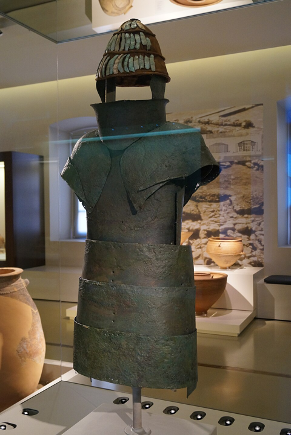
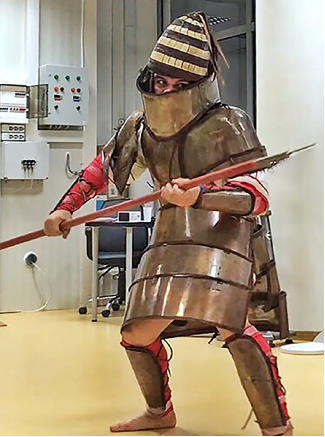
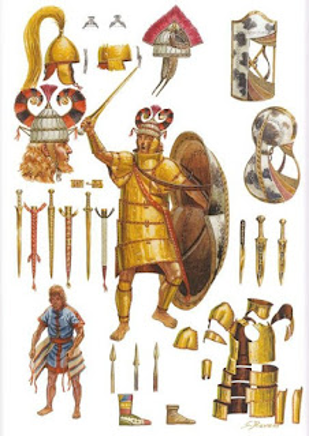
Would we expect a film adaptation set in the Bronze Age to clad its hero in a faithful reconstruction of this armor? No, of course not. There are both practical and artistic reasons not to subject Matt Damon to this design; the collar covers his face, the silhouette is deeply unflattering to a modern viewer, et cetera. I would classify these as understandable reasons to modify the design.
So instead of accuracy, let’s analyze these images in terms of authenticity. What material culture does this armor demonstrate? Four features stand out to me:
- Bronze. A lot of bronze. It’s the Bronze Age, after all.
- Bone. The helmet, especially, is made of overlapping scales of boar’s tusk. Not only is this style of helmet attested in the archaeological record, it is actually directly referenced in Book 10 of the Iliad, worn by none other than Odysseus.
- Big shields of varying shapes. Prior to the classic round aspis of the Polis Era hoplite, large animal-hide shields, often crescent- or figure-eight-shaped, are frequently depicted.
- Put together, the warrior presents a formidable wall of solid armor, well-protected and clearly wealthy enough to afford his kit.
Therefore, at a minimum, a costume designer with an eye on authenticity might try to create a piece with:
- Lots of bronze. Because it’s the Bronze Age. Not actual bronze, for the sake of the actors and budget, but material that looks and moves like bronze, even (especially) in the close-up shots.
- Some overlapping scales of bone, preferably on the helmet, but we’ll allow room for creativity.
- Big crescent or figure-eight shields.
- An imposing, heavy silhouette which demonstrates the character’s high status, both literally and metaphorically.
So, how do the costumes in Nolan’s Odyssey hold up to this standard? Badly. Really, really badly.
Though the obvious example to analyze would be the much-mocked Batman-ification of King Agamemnon, let’s get more creative. As silly as “Batamemnon” is, Nolan clearly wanted him to stand out and look frightening (which is virtually all he does in this movie), even if the result was ultimately ridiculous. Instead, let’s look at the “uniforms” of the average Trojan grunt in the film’s many flashback sequences. The image below is from a promotional shoot rather than a frame from the movie, as few are yet available. However, those who have seen the film will note that this is really what these guys look like:
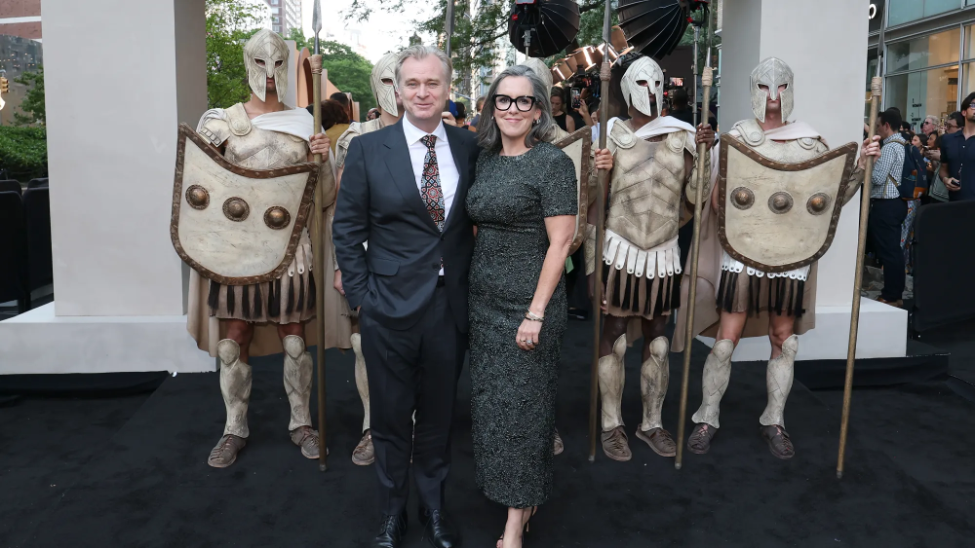
Let’s apply the arbitrary standards we set earlier:
- Um, where’s the bronze? It’s the Bronze Age.
- Bone? Maybe the head-to-toe white ensemble is supposed to give the vague implication of bone? If so, bad job.
- Well, I guess the shield is vaguely crescent-shaped? But why on earth is it so tiny? And what is going on with those three definitely plastic shield bosses?
- The silhouette is less “imposing Bronze-age warrior” and more, well, a guy in a very poorly fitted costume.
I think this last point sums up my frustration. There is a difference between costume and clothing. An audience immersed in the world of the Odyssey shouldn’t look at the screen and see actors in costumes, they should see Trojans in armor. What visual language is Nolan trying to convey in the material culture of his world? Nolan goes out of his way to remind us, ad nauseum, that the Bronze Age Collapse is imminent. So what visually tells us “these people you see on screen are mighty kings of Bronze Age Hellenic civilization on the verge of a catastrophic societal collapse, you’re just observing them at this specific moment in their life”? Nothing. This doesn’t look like the Bronze Age, it looks like Hollywood A-listers and random extras at a costume party. It looks like the generic pseudo-history aisle at everyone’s favorite pop-up costume chain Spirit Halloween. It looks like it belongs between the horned Viking helmets and the Cleopatra bangles. It looks like they’re wearing foam and plastic because they’re wearing foam and plastic. This movie had a budget of $250 million.
For comparison, let’s juxtapose our bargain-bin Trojans with the last time Homer was given the big-budget Hollywood treatment: Wolfgang Petersen’s Troy (2004). This movie has an understandably poor reputation among classicists for the creative liberties it takes with the Iliad’s narrative, but let’s set the storytelling aside and just look at the costumes.
Here are Petersen’s Trojans:
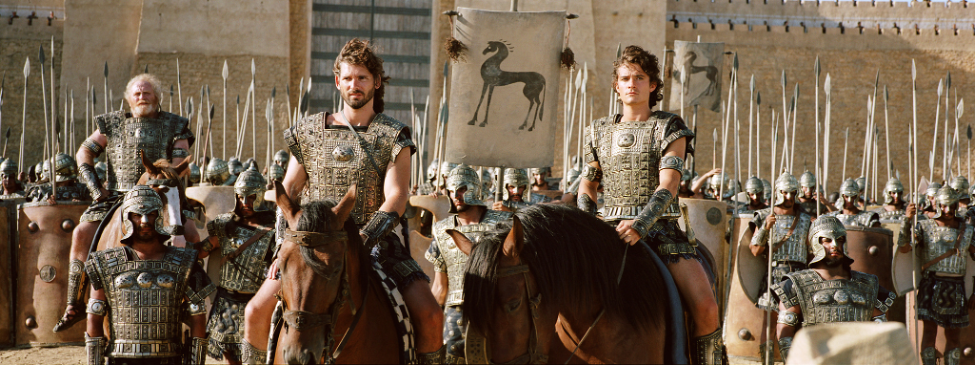
And here are his Greeks:
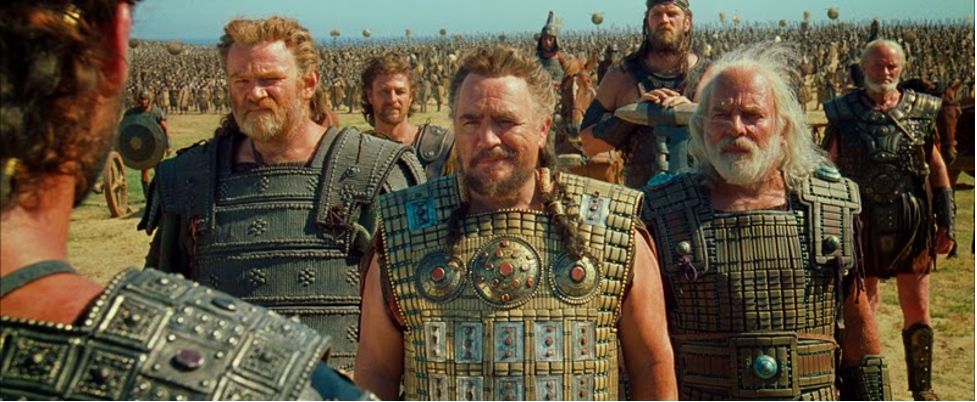
Historically accurate? No, definitely not. Historically authentic? Well, let’s give it a shot.
- Bronze? The Trojans get a silver and blue palette to contrast the more earth-tone Greeks, but look at all that hand-hammered metal. The costumes themselves are almost certainly plastic, but they look like they could be blackened, polished, or tinned bronze. We look at those panoplies and imagine that, to some degree at least, they could have adorned the heroes of Homer’s epic.
- Bone? Not quite, but note in the second image that the weird cross-hatched pattern on Agamemnon’s (center) and Nestor’s (right) armor is not dissimilar to the overlapping boar’s tusks of the Dendra helmet. Ajax (behind Agamemnon) certainly sports some silly bone jewelry. It may be a stretch, but I’ll take what I can get.
- Big crescent and figure-eight shields? Yes, actually, especially in wider shots of the Greek army.
- An imposing, regal, armor-clad silhouette? YES.
Clearly, major creative liberties were taken with the costumes. Arguably, this is a relatively poor example of authenticity by our high standards. No, Petersen’s Troy does not accurately depict the Bronze Age. But it is extremely clear that the costume designers put a massive amount of effort into developing a visual language directly inspired by the material culture of the Bronze Age Mediterranean. Though the details diverge wildly from historical reality, the defining material culture of the era is, at the very least, paid a loving homage.
I think the greatest tragedy of Nolan’s Odyssey from a historical perspective is that Hollywood seems to have decided it just doesn’t really care about historical authenticity. No, Elon, it isn’t because they hate white people. But it also isn’t because it’s fantasy. Look no further than Peter Jackson’s Lord of the Rings trilogy for the results of immense passion and effort put into a completely fictional material culture. Clearly, between 2004 and 2026, there seems to have been a decline in, if nothing else, an affection for historical costume design – the kind of affection that produces intricate, lovingly designed and crafted pieces which, in and of themselves, contribute to the adaptation’s themes and narrative.
Maybe it was 300’s devotion to heightened spectacle (hey, at least they were wearing bronze, if not much else). Maybe it was Game of Thrones’ insistence that “the past” has to be grubby and bleak (though, ironically, Game of Thrones and its spinoffs do a pretty good job in the costume department). Maybe it was Vikings’ insistence that Big Warrior Man = black leather and as many random straps as we can get away with. Maybe it was Bridgerton, which shared the Odyssey’s costume designer, and its strange blend of historical and modern. I am sure there are industry reasons that I, a mere pleb, could never hope to understand. Budget, at least, is very clearly not one of them.
Simply put, the material culture in Nolan’s Odyssey is worse than bad. It’s lazy. The Bronze Age may be collapsing, but it deserves better than this.
By: Ilan Davidowitz
Image Credits:
- Dendra Panoply: https://en.wikipedia.org/wiki/Dendra_panoply#/media/File:Mycenaean_armour_from_chamber_tomb_12_of_Dendra_1.JPG
- Dendra Panoply Recreation: https://www.sci.news/archaeology/dendra-armor-12959.html
- Bronze Age Warrior illustration: Giuseppe Rava, from Bronze Age Greek Warrior, 1600-1100 BC (Osprey Publishing), https://www.ospreypublishing.com/us/bronze-age-greek-warrior-16001100-bc-9781849081955/
- Christopher Nolan and his Troy Boys: https://www.hollywoodreporter.com/movies/movie-news/christopher-nolan-inside-trojan-horse-the-odyssey-premiere-1236648771/
- Troy (2004) Trojans: https://www.alamy.com/eric-bana-orlando-bloom-troy-2004-image475568126.html?imageid=8E8C7F30-DA98-432E-9604-7BAA9E534F34&pn=1&searchId=253df0b84d7811e88e7778de5ddbd92e&searchtype=0
- Troy (2004) Greeks: https://moviemusings.uk/2017/12/01/troy-review/
