

The story of Esther is fiction. There was no king Ahasuerus, or valiant woman Esther, or even her uncle Mordechai. However, it’s a very popular story and is celebrated in the Jewish spring holiday of Purim. The holiday might have roots in Babylonian society, but no one is really sure.1
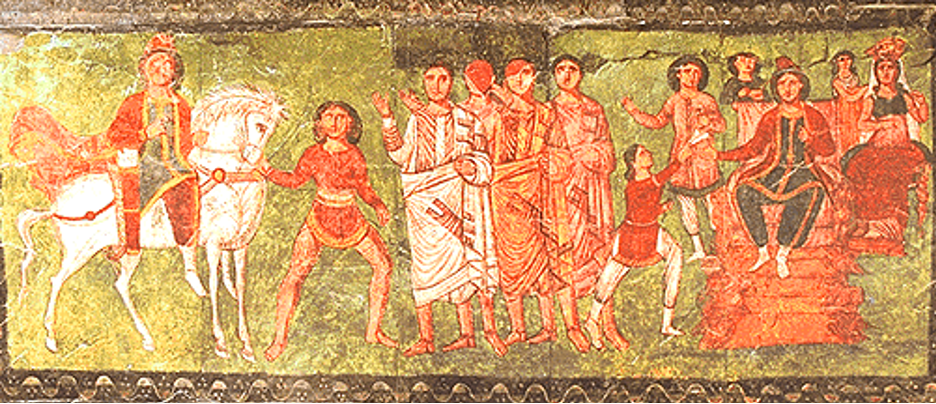
It was probably written some time in the 4th Century BCE and added to the Tanakh, the Old Testament, about 200 years later. The murals at Dura Europos (c. 245 C.E.) tell the story of Esther, and the characters are all in Persian, Roman or Hellenistic costume.
The following maps show where Dura Europos would be today.
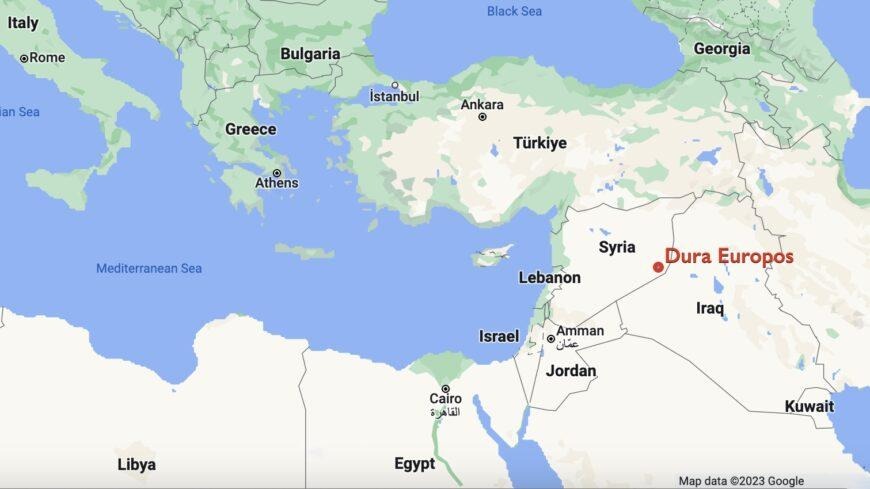
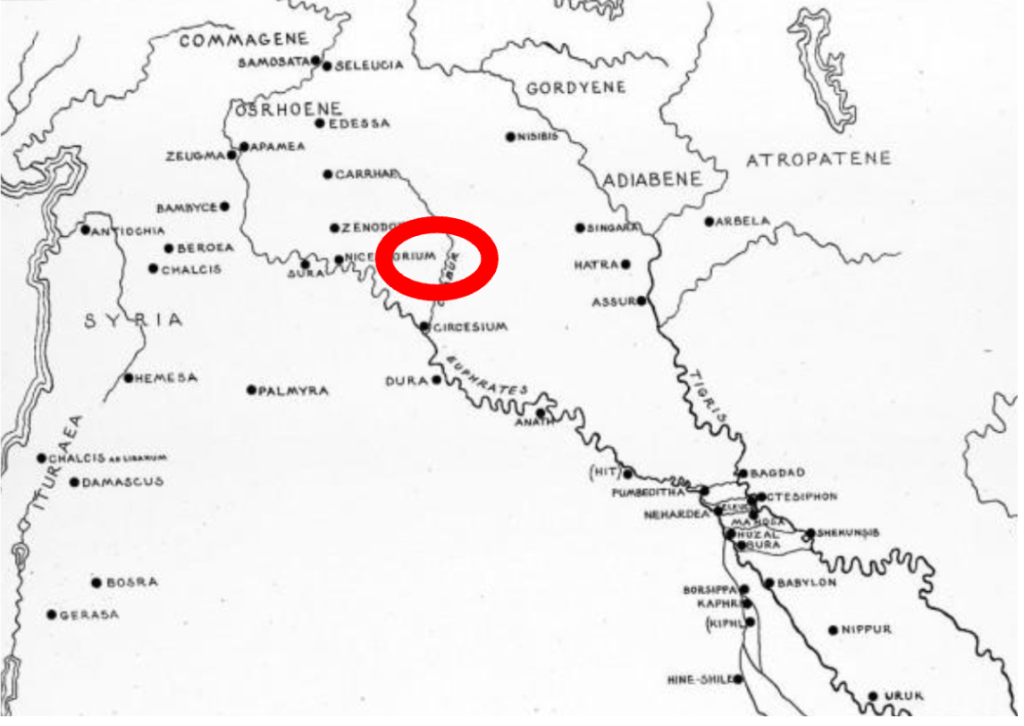
Dura Europos was always a multi-cultural city.
Seleukos Nikator, one of Alexander’s companions, took over this part of Alexander’s conquest after Alexander died. He founded the Seleucid Empire. Dura Europos was established around 300 BCE. Europos is the name of the city Seleukos came from, and Dura means fortress in Aramaic, or perhaps Assyrian.
In 133 BCE, the Parthians took over. In 116 CE Trajan conquered Dura, but the Roman rule didn’t last that long. In 121, the Parthians returned. However, in 164 CE the Romans came back. Sometime over the next 35 years a house was converted into a synagogue, and the paintings were in place between 244 and 254 CE. In 256–257 CE – Dura fell to the Sassanid king Shapur I and the population was deported.
As a city under Seleucid control, the population was a mixture of Macedonian and Greek colonists with the local Semitic inhabitants. The Seleucid rulers were very tolerant of various religious beliefs, whether Greek, Roman or even Jewish.
After 257 CE, when the city was devastated, Dura Europos lay in the sands until the 1920s, and archaeological work began in earnest in the 1930s. Excavation was ongoing until around 2015, when ISIS completely destroyed the site, killing workers, and Dura Europos is no more. Luckily copies, though not the original, of the synagogue wall murals were taken to the museum in Damascus, and copies are also in Israel and at Yale University.
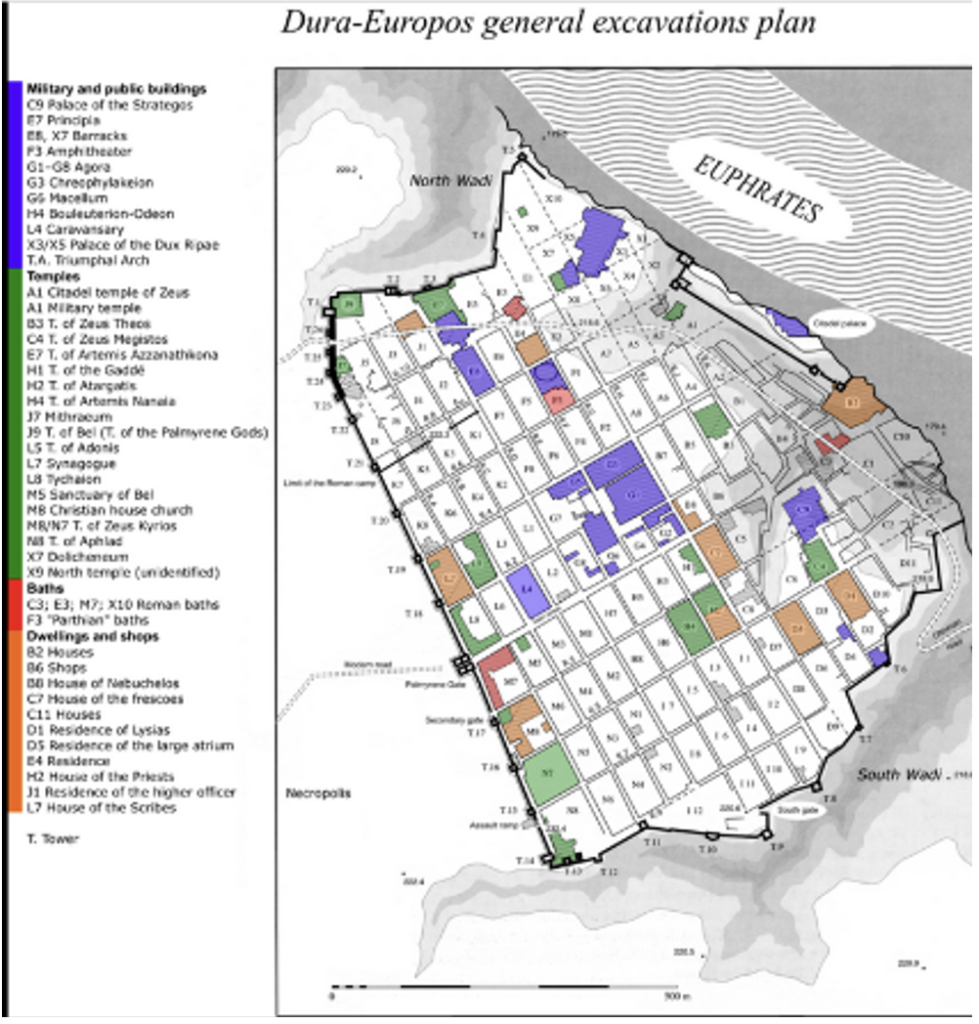
Here is the city plan; it was a large city for the time. The synagogue was located in area L7, next to the western wall.
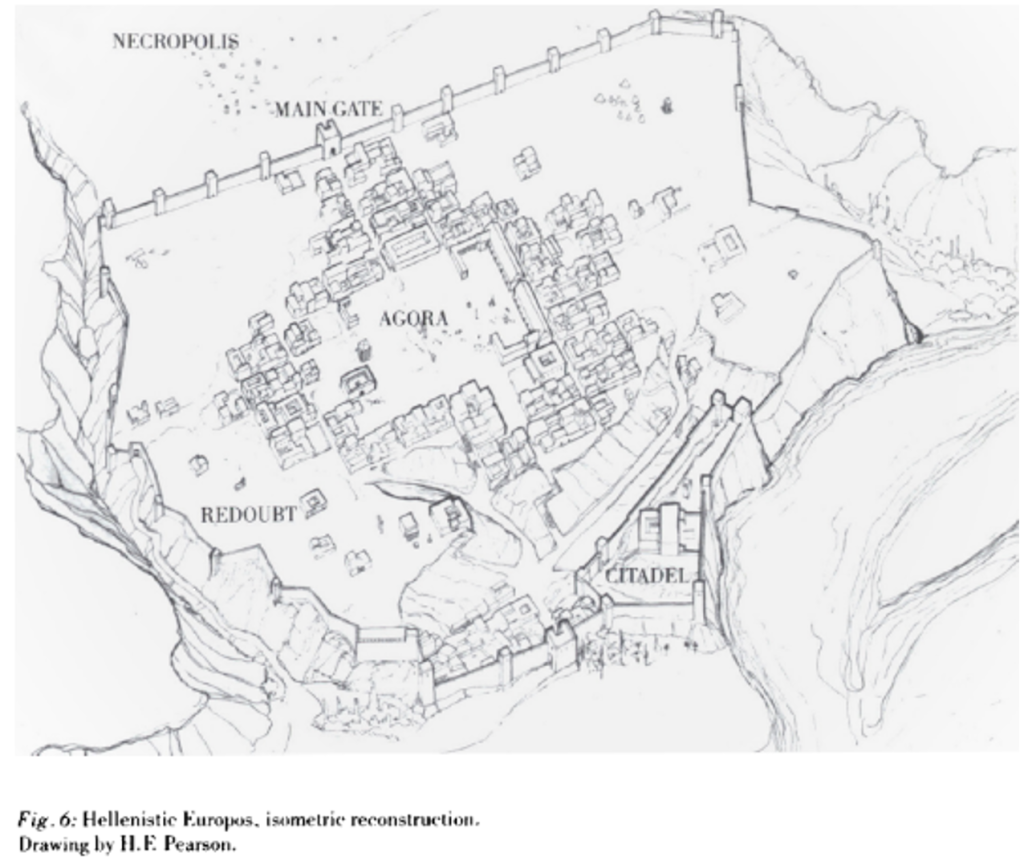
We in the West do not expect to see paintings in a synagogue, but they were common in the East and even in Poland before World War I. These are all scenes from the Bible, and none of them show God.
The Esther panel is on Western Wall, just to the left of the Torah niche, giving her story a very prominent position. To the right, one picture over, is Pharoah’s daughter.
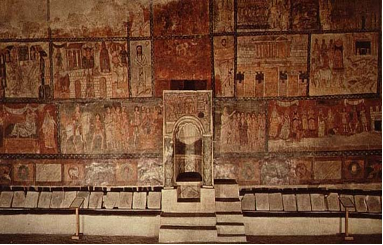
Why is the story so prominently displayed? There is some thought that, since the story shows the downfall of some evil Persians – Haman and his family and followers – the Jews of Dura Europos were reacting to the idea that Persians would come and destroy Dura. On the other hand, why stories with women? Here is a feminist idea: women came to pray and were inspired by the pictures of strong women and perhaps would be like them in resisting Roman rule.2 Thus Esther’s clothing, which is Hellenistic in style, separates her from the Persians and their king. On the third hand, this is definitely a folk story, well-known and probably couldn’t be omitted.
The mural in done in “comic book” style, where you read from left to right. ‘Dura’s paintings have been called the “oriental forerunners of Byzantine painting,” and their preference for frontal poses, schematic rendering of the human figure, and loving attention to decorative detail and linear pattern at the expense of naturalistic proportions, anatomical veracity, and movement can indeed be described as oriental traits.’3
Here is a brief recap of the entire story. Only part of it is featured in the mural. Remember that the ethos of that time regarding women was quite different from today, not to mention the way people were killed.
King Ahasuerus seeks a new wife after his queen, Vashti, refuses to obey him and show herself to the court in an unseemly manner – perhaps naked. There is a contest among the virgins in the city to be the next queen, and Esther is chosen for her beauty; her uncle Mordechai tells her not to let on that she is Jewish, and so she doesn’t.
By the way, Esther (meaning “star”) is a Persian word; in Hebrew she is Hadassah (meaning myrtle tree). Some commentators said she used a Persian name to disguise the fact that she was Jewish.
She “goes to” the king, who falls in love with her and makes her queen. Later Mordechai learns of a plot against the king and tells Esther to inform the king. The king’s chief adviser, Haman, is offended by Mordechai because he won’t bow down to Haman, and gets permission from the king to have all the Jews in the kingdom killed. Mordechai convinces Esther to go to the king to save the Jews.
Esther invites the king and Haman to a feast, and Haman is so excited by the favor shown to him that he sets up a stake to impale Mordechai. The king finds out that Mordechai was the one who warned him of the plot, and decides that Mordechai should be honored, so he tells Haman to lead Mordechai on a horse through the streets as a sign of favor. This is where the mural begins (with some omissions).
At the feast that night, Esther tells the king that Haman was about to kill all her people. The king, angered, goes into the garden to think. Haman falls at Esther’s feet and begs for mercy. However, when the king comes in, he thinks that Haman is attacking Esther and sends Haman to his death on that same stake.
Mordechai becomes the counsellor and the edict against the Jews is rescinded by making a new law, that the Jews can kill their enemies, and they do so. They also have the 10 sons of Haman impaled on the stake! This then becomes a holiday.
What makes this story interesting is that there is no mention of God here; all action is via humans. This is one reason why there was controversy about admitting it to the canon of the Jewish writings.
Personally, I think that it was finally accepted because people loved the story so much – both for its heroine and the excitement of actually winning a victory – that it just had to be added to the canon.
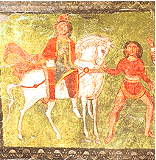
In the first part of the mural, Haman is leading Mordechai on a horse, as a sign of honor. Note that they both wear Persian clothes.
One scholar says: this depicts a typical Roman triumphal procession that the Jews would have seen on the coins of Septimius Severus in circulation at the time.4
It has also been posited that the artists had used typical Roman conventions, the meanings of which would have been easily understood by anyone living in an urban city such as Dura, to illustrate an historic Jewish victory.
I’m not so sure about this historic victory, but the iconography would be well known.
Dr. Levit-Tawil5 suggests that the portrayal of Mordechai is reminiscent of early Sasanian royal iconography and thus conveys the expectation that Shapur I would protect the Jews.
What about these people in the middle?
They are certainly not wearing Persian style clothing, and their garments do look like Roman togas. Many commentators skip over an explanation for these 4 people – no surprise to us, as we are used to scholars, when unsure, just omitting information!
However, to summarize Dr. Kogman-Appel6:
Although completely motionless they are clearly visible and mark the centre of the composition, as the dynamic narrative, dominated by wearers of Persian garb, develops on either side of them. They cannot be identified with any of the figures in the story, but seem to be anonymous representatives of a collective group of observers, witnesses of the favourable turn of events.
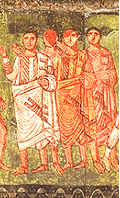
On the other hand, Dr. Sabar7 believes that the figures are cheering on Mordechai, and therefore are against the Persians.
However, he then goes on to say that considering the graffiti, which admires the paintings, perhaps the locals, showing them off to visiting Persians, told them how wonderful Ahasuerus, the Persian, was when he saved the Jews. Talk about having your cake and eating it too!
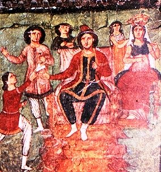
Here is Esther, dressed on a throne, sitting next to Ahasuerus’ left side.
“Esther’s costume is elegant and aristocratic: she wears a sleeveless corset, long skirt, cloak and veil; her neck, upper arms, and wrists are adorned with jewelry… the golden crown consists of a wreath on its lower part, from which a mural superstructure emerges with three protruding towers resembling the image of a city wall.”8
Her crown, however, is “oriental.” 9
Because of this, Esther is viewed as a form of Tyche with her crown, standing for “good fortune and fertility. and therefore protection of the city”.10 Remember the story of Hannah in the Old Testament, where she goes to the temple to pray for a son, the very definition of fertility. That type of crown is common among goddesses in the ancient world; it shows that they protect the city. In addition:
“The mural crown as a royal insignia has a long history in the ancient Near East and also in the Roman Empire.”11
Cybele also wears a crown. Does the fact that Esther is wearing a crown mean that she is a goddess? Some scholars think that she is a form of Ishtar (note the crown) and Mordechai, her uncle, is a form of Marduk.
In terms of the clothing:
“All figures presented within the panel, except for the 4 in the middle and Queen Esther, are wearing Persian-style clothing.”12
In the all the Dura synagogue art only Esther’s outfit reflects a combination of Greek garb and Near Eastern headwear; all the other women appear in purely Greek attire.
In the background, “are male and female attendants and approaching them is a scribe and a messenger. This messenger is either about to give to or receive a message from King Ahasuerus.”
Further closeness with Persia’s kingship is seen here:
“[It] not only portrays the Biblical tradition [of the Jews], but also displays Iranian notions of kingship and the receiving of royal glory.”13
Thus the Jews and Iranians have a mutual vocabulary.
As for Esther, Dr. Kogel-Appel14 believes “that Esther looks like representations of Julia Domna (d. 217 CE), Septimius Severus’ Syrian wife, and that the Jewish patrons and artists meant to mark the end of a Roman era that was beneficent towards the Jews; Septimius Severus and Julia’s reign was followed by turmoil.
There are Middle Persian graffiti on the various people and things. Here is one on Mordechai’s horse.15
These graffiti appear only on the lowest register of the wall paintings—and can be reached while still standing on the floor and benches of the synagogue. These inscriptions represent the responses of viewers of the synagogue, sometime between 245 and about 256 CE.
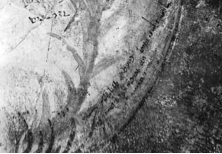
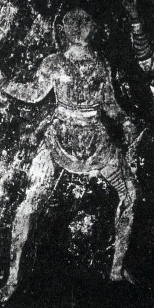
Six inscriptions record the visits of Persian speakers to the synagogue, using similar formulae.
A graffito (below on the left) on Haman’s leg calls the synagogue “the edifice of the God of Gods of the Jews.”
The picture on the right has graffiti on the himation, the outer garment, of one of the four people watching the procession:
The month Frawardin in
The year 15 and the day Rasin
When Yazdantahm-Farrabay,
The scribe of Tahm [or, valiant scribe],
[came] to this house, and he
Appreciated [or, approved] this picture16
We can’t see it in this picture, but I’m sure it’s there!
These writings prove that not only was there contact between the Persians and Jews, but that they also were interested in each other. Certainly the Persian story was a draw for Persian visitors.
To conclude: the story of Esther was well known and quite loved by Jews. It has prominence in the synagogue perhaps as a tale of valor, or maybe as a story of great victory. As an adventure story, it appealed to all ages and groups. The combination of Roman, Hellenistic and Persian dress and styles speak to the multi-cultural city of Dura Europos and to us today.
By Ruth Breindel, who taught Latin, Greek, Linguistics and Mythology at Moses Brown School for 30 years.
- https://jewishchronicle.timesofisrael.com/the-origins-of-purim/ ↩︎
- “Part of the Same Miracle” Women and Visual Art in the Dura Europos Synagogue, Sarah E. G. Fein, pp. 98-9 ↩︎
- DURA · EUROPOS THE ANCIENT CITY AND THE YALE COLLECTION. Susan B. Matheson, p. 26
↩︎ - Kogman-Appel, p. 378 ↩︎
- as quoted in Kogman-Appel, p. 378
↩︎ - Kogman-Appel summary by R Breindel ↩︎
- The Purim panel at Dura: a socio-historical interpretation. Shalom Sabar, p. 153
↩︎ - Goddesses in the Synagogue? Géza G. XeravitsJournal for the Study of Judaism 48 (2017) 272 ↩︎
- Fein, p. 104 ↩︎
- Fein, p. 104 ↩︎
- Xeravits, p. 274 ↩︎
- Dress Codes in the Synagogue of Dura Europos? Katrin Kogman-Appel in Synagogues in the Hellenistic and Roman Periods, ed. Doering & Krause, p. 373 ↩︎
- Touraj Daryaee. TO LEARN AND TO REMEMBER FROM OTHERS: PERSIANS VISITING THE DURA-EUROPOS SYNAGOGUE*, SCRIPTA JUDAICA CRACOVIENSIA * Vol. 8, Kraków 2010. p. 34 ↩︎
- Kogman-Appel p. 378 ↩︎
- kraeling inscription no. 45; detail of panel WC2 ↩︎
- https://web.library.yale.edu/judaica/site/collection/collection.html; In_small_scratches_forgotten_new_perspec.pdf ↩︎