

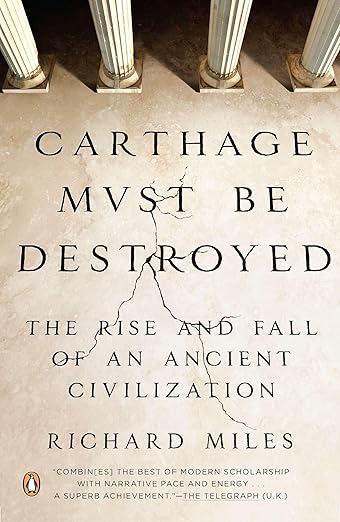
Carthage Must Be Destroyed: The Rise and Fall of an Ancient Civilization. Richard Miles, Viking 2010.
For the general reader:
This book was very interesting to me as it actually gave a history of Carthage for the general reader. The description of the trade routes, colonies and mercantile agreements which made up the Western Mediterranean Sea trade (Sicily, Sardinia and the Ligurian coast and later, Spain) were all new to me. Agreeing that the Carthaginians sacrificed children, he points out that this was a common practice in the eastern Mediterranean culture from which Carthage descended (vide Abraham, Isaac and the ram). He also spends a lot of time on the similarities of the Heracles and Melqart myths. I was somewhat jarred by his use of BC instead of BCE in a book published in 2011, as by his reliance on Livy as a source for the Punic wars; in college, 60 years ago, I was taught that Livy was unreliable. But, overall, I found it very interesting.
By: Daniel A Bronstein, Professor Emeritus, Michigan State University
For the classicist:
This book is incredible in its detail, and is not something to just sit down with and read through; it is more like tasting a fine wine, where you sip at it and then put it down for a few minutes (or days) until you are ready for more. The book is a wonderful resource for teachers, with interesting information (some of which is given below) and also chapters that would be great for students to read before translating things about Carthage: Dido and Aeneas, Hannibal, Scipio, etc. The footnotes go on for 78 pages and the bibliography for 37 pages.
Here are some of the fascinating things I discovered:
- Sardinia was a source of food, trade goods and natural resources. I didn’t even know that the Carthaginians had been in Sardinia!
- The different version of Dido; while we all know that Vergil made up his version, here was one I hadn’t heard of. In addition, see pp. 365-370 for a discussion of Dido and Aeneas.
- There were child sacrifices in Carthage; scholars have gone back and forth, but Miles presents excellent evidence for them.
- The relationship between Rome and Carthage had a long history of battles and treaties without battles, going back to the early years of Rome. The two even joined together at times against Pyrrhus. However, “In fact the main antagonists of the First Punic War drifted into the conflict less for reasons of grand strategy, and more for the lack of political will to prevent it.” (p. 176)
- A totally different version of Regulus than is presented in the old Jenney (how could this be?)!
- Cartagena, in Spain, means New Carthage, and Carthage itself, as we know, means New City. So Cartagena is New New City! It was established by Hasdrubal in 227 BCE.
- Roman authors wrote about the war as “a broader overarching frame of ancient myth.” Over the next 20 years after the destruction of Carthage, Carthage was an example both “virtue and vice” to the Romans, depending on the author.
Other highlights of the book:
- A good discussion of the relationship between the Carthaginian god Melqart and Hercules. This is a recurring theme throughout the book, explaining cultural and political realities. Later, Miles talks about Hannibal’s relationship with the gods. He is extremely impressed by Hannibal!
- The biases of various ancient writers (and even some modern ones!) is dealt with, showing that some had a clear view, and others moved back and forth between good and bad Carthage, not to mention good and bad Rome.
- The First Punic War – discussion of naval equipment and warfare. Then, a treatment of the internal wars among the Carthaginians after the War, which led to Carthage conquering Spain.
- Hannibal, from Hasdrubal’s line, became leader in Spain and took over Saguntum due to dallying in the Roman Senate. There is a great deal of information about Hannibal’s army. The march through Italy is very, very, very thorough…
- Propaganda was very important in the ancient world. We think of that with Caesar, but not often with other generals. However, Hannibal used propaganda quite effectively. By the way, I did a unit on propaganda in Caesar, Vergil and America from World War II to the present. If you’re interested, email me for it.
- After the First Punic War, Carthage traded with Rome and expanded beyond its city boundaries.
- The Roman Senate, after winning the Macedonian War in 168 PCE, had expansionist ideas. Carthage and Numidia fought over land; Carthage lost and Rome came to destroy it. Rome gave harsh terms and so war was declared. This led to the siege of Carthage under Scipio Aemilianus.
- In 29 BCE Augustus began to rebuild Carthage as Colonia Iulia Concordia Carthago.
Less tangible, but equally important, was the key role that Carthage played in the creation of a Roman national character. The brutal destruction of the city gave the Romans the freedom to transform Carthage into the villainous antitype against which the ‘Roman’ virtues of truthfulness, piety and duty could be applauded. As long as the Romans needed proof of their greatness, the memory of Carthage could never die (p. 373).
By: Ruth Breindel