

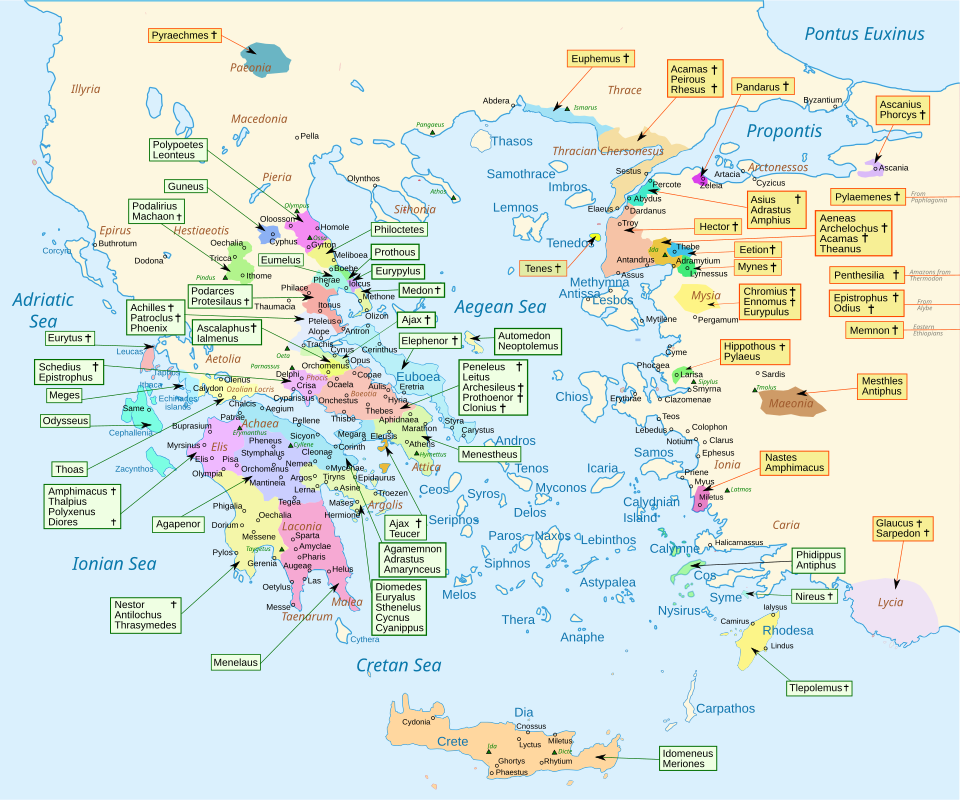
I came across this map when reading the Catalog of Ships in Iliad Book 2. It helped make sense of the geography of the Catalog.
The map also connects the individual heroes mentioned in the Iliad with their homeland, adding context for readers unfamiliar with Homeric geography, and reminding the reader of the relationships between warriors from the same territory.
For example, in Book 6 Glaukos of Lycia introduces himself to Diomedes of Argos by tracing his own (Glaukos’) lineage back to Sisyphus of Ephyre. Ephyre, according to Richmond Lattimore’s Glossary at the end of his translation1 is the Homeric name for Corinth, the city generally associated with Sisyphus. On the Wikimedia map it is clear that Corinth is located on the doorstep of Diomedes’ own homeland Argos, so Glaukos is making the point, as he faces this fierce enemy Diomedes on the battlefield, that generations ago their families were once neighbors. By viewing Corinth (= Ephyre), Argos (with Diomedes’ name attached), Troy, and Lycia (with Glaukos’ name attached) all on one map, it is easy to see what Glaukos is up to.
By Margaret McGill, emerita
Permission is granted to copy, distribute and/or modify this document under the terms of the GNU Free Documentation License, Version 1.2 or any later version published by the Free Software Foundation; with no Invariant Sections, no Front-Cover Texts, and no Back-Cover Texts. A copy of the license is included in the section entitled GNU Free Documentation License.

- (The Iliad of Homer,Translated with an Introduction by Richmond Lattimore, 1951 The University of Chicago) ↩︎